
Manufacturing depth
In partnership with Cinderella Project
pink × Cinderella Manufacturing depth
How a custom machine like pink becomes possible

Six industrial processes, six global category leaders — under one roof in Prague.

pink is not a one-off prototype assembled from off-the-shelf parts. It is built in PhotoRobot's manufacturing facility around six industrial-grade processes, each anchored by a recognised category leader. That depth is what makes a customer-grade industrial deployment for a five-country medical trial deliverable in months — and viable as a serviceable long-life device, not a research prototype that breaks after the grant expires.

01

Sheet metal processing

TRUMPF TruMatic 1000 + TruBend 5170 · Ditzingen, DE

TRUMPF is the global benchmark for sheet metal — fibre lasers, press brakes, automated bending cells. PhotoRobot's TRUMPF cell handles every steel and aluminium panel that becomes part of a machine: structural frames, cabinet skins, brackets, mounting plates. Cuts are clean, fold tolerances are tight, finished panels arrive at assembly with the dimensional discipline downstream operations rely on.

For pink: the cabin's curved white panels, the structural frame, the camera-tower housing — all start at the TRUMPF cell.
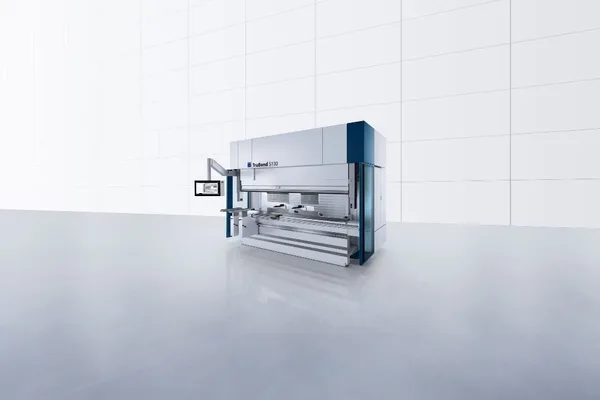
TRUMPF sheet-metal cell — fibre laser, press brake, automated bending Image courtesy of TRUMPF GmbH
02

5-axis turn-mill

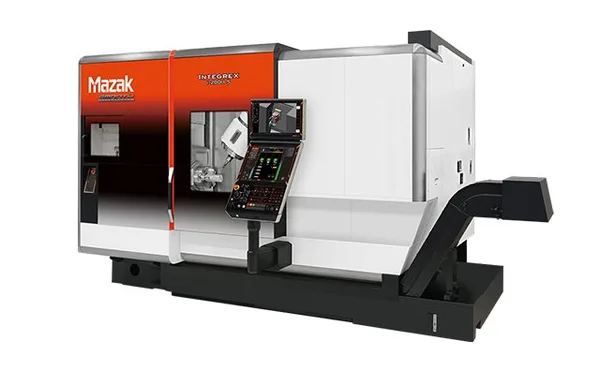
Mazak INTEGREX i-100H ST · Yamazaki Mazak, JP

The INTEGREX is Mazak's flagship multi-tasking platform — turning and milling on a single machine, holding tolerances tight enough that downstream assembly does not need fettling. PhotoRobot's INTEGREX produces the high-precision mechanical components inside every machine: bearings housings, drive-train interfaces, camera-mount adapters, the small load-bearing pieces that decide whether a machine survives ten thousand cycles or breaks at three.

For pink: the camera positioning hardware, the precision adapters that interface Canon optics to the cabin structure, the rotational components in the motion system.

Mazak INTEGREX multi-tasking turn-mill platform Image courtesy of Yamazaki Mazak Corporation
03

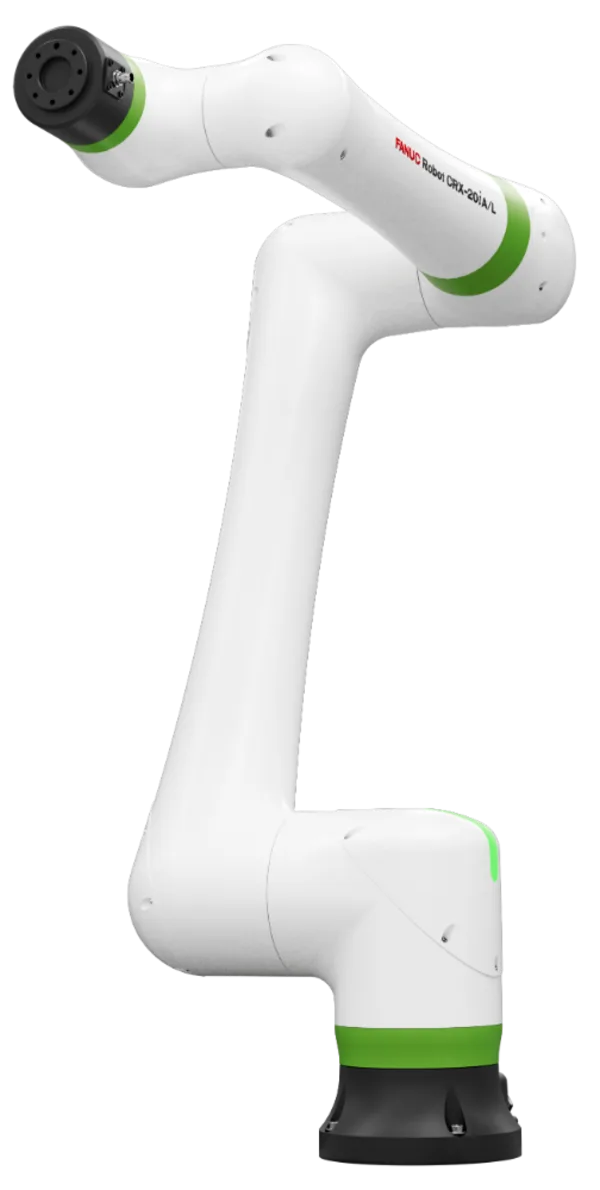
Robotic automation

FANUC CRX-20iA/L · Yamanashi, JP

FANUC robots are the workhorses of automated industry — robust, serviceable for a quarter-century, supported worldwide. PhotoRobot uses FANUC cells for repeatable assembly operations and for the motion subsystems built into machines where photographic capture sequences need to be deterministic and reliable session after session.

For pink: the motion-control pattern PhotoRobot has refined over a decade of industrial photography deployments, scaled down to clinical-room form factor and clinical-room noise budget.

FANUC robotic cell — handling and automation Image courtesy of FANUC Corporation
04

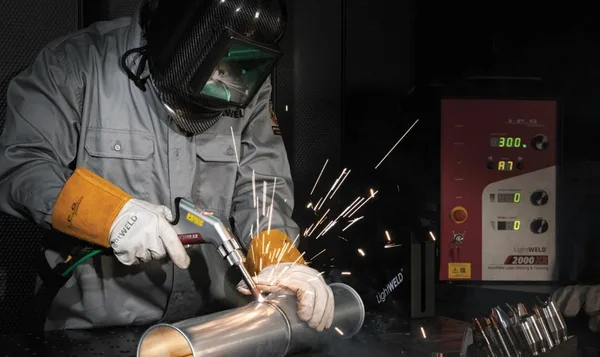
Laser welding

IPG LightWELD XR · Oxford, MA, US

Laser welding allows joints that are simultaneously stronger, cleaner and lighter than equivalent TIG or MIG work, and that survive the long-term cyclic loading industrial photographic hardware sees. IPG is the dominant fibre-laser supplier worldwide; PhotoRobot's IPG cell handles the structural welds in load-bearing components.

For pink: structural sub-assemblies that will live through ten or fifteen years of clinical-room cycles and need to maintain dimensional integrity throughout.

IPG fibre-laser welding system Image courtesy of IPG Photonics
05

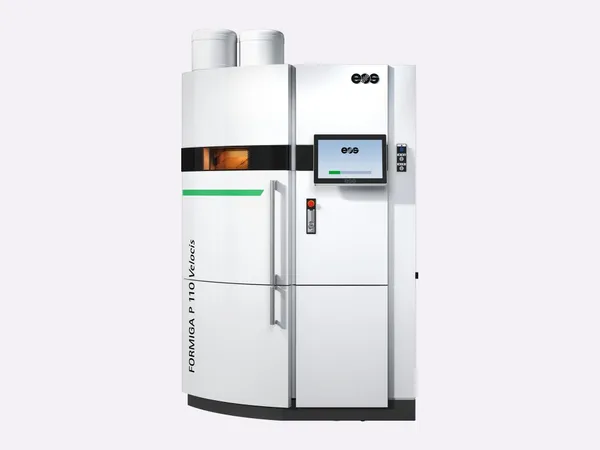
SLS 3D printing

EOS FORMIGA P110 Velocis · Krailling, DE

Selective laser sintering is the production additive-manufacturing process that has earned its place alongside subtractive machining — for parts where geometry is more important than commodity cost, and where the design iteration cycle is more valuable than tooling investment. EOS is the German category leader; PhotoRobot's EOS line produces plastic and metal-replacement parts where injection moulding would be slower, costlier and less flexible.

For pink: bespoke interior fittings, custom brackets that hold non-standard equipment in non-standard geometries, parts that exist in tens rather than tens of thousands.

EOS industrial additive-manufacturing platform — selective laser sintering Image courtesy of EOS GmbH
06

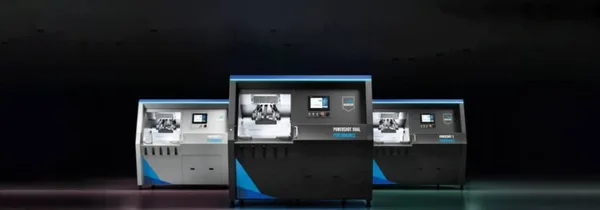
Plastic part finishing

DyeMansion Powershot Performance · Munich, DE

Raw SLS prints arrive with a rough, porous surface that is unsuitable for any customer-facing application. DyeMansion's finishing platform — surface conditioning, dyeing, sealing — turns sintered powder into parts that look and feel like injection-moulded production components. It is the difference between a 3D printed part you ship to a hackathon and a part you ship to a hospital.

For pink: every patient-facing surface that began life on the EOS line passes through DyeMansion before installation. Patients see finish; finish is what DyeMansion delivers.

DyeMansion finishing platform — surface, colour, sealing Image courtesy of DyeMansion GmbH
pink in build

From CAD to clinical-room installation in weeks, not years.

pink's first prototype came together across late 2022 in the Prague facility. Sub-assemblies from the six pillars above converged on a single build floor; engineering iteration ran in parallel with assembly; the first machine shipped to Lisbon for installation while serial production capacity for additional units was already coming online.

pink prototype mid-build — early structural assembly
Mid-October 2022 — structural assembly in progress.
pink prototype mid-build — internal fit-out
Internal fit-out — cabin geometry taking shape.
pink prototype mid-build — assembly detail
Assembly detail — fitting and alignment.
pink prototype build floor — Prague facility
Build floor — Prague facility, mid-October 2022.
pink prototype — early November, near-finalised state
Early November — near-finalised, pre-shipment.
pink prototype — finalised state ready for installation
Finalised — ready to ship to Lisbon.
Why this matters for medical-grade deployments

Repeatability, traceability, and a serviceable lifetime — without compromise.

pink lives in clinical environments. The expectations there are different from the expectations of consumer-grade or even most industrial-grade equipment. A handful of properties matter disproportionately, and PhotoRobot's manufacturing depth is what makes them realistic to commit to:

None of this is unique to pink. The same engineering stack ships PhotoRobot machines into luxury fashion fulfilment, automotive reconditioning, aerospace component documentation and several thousand additional industrial deployments worldwide. pink is one application of the capability — the most demanding application to date in terms of regulatory expectation, and arguably the most rewarding in terms of patient outcome.

"A project designed to improve patients' satisfaction and quality of life after breast cancer surgery and radiotherapy."

The Cinderella project — official tagline. The Prague factory exists to make this kind of project possible.